
Officials Data center home / For officials / The public-health evidence about noise
Pathway from problem to solution:
The public-health evidence about noise
Noise is not simply an “annoyance” or a “nuisance,” it is a public health problem, declared by by US Surgeon General William Stewart in 1968 and elaborated over 50 years ago by acoustic pioneer, Karl Kryter, in his seminal work, The Effects of Noise on Man. Since that time the scientific evidence has grown dramatically. Today, we know that chronic noise, even at low levels, can cause annoyance, sleep disruption, and stress that contribute to cardiovascular and cerebrovascular disease, metabolic disease, psychological disorders, neurodegenerative diseases, and even premature mortality. Noise also interferes with children’s learning and behavior problems. The strength of the evidence forms the basis for noise guidelines from the World Health Organization and for policy statements from the American Academy of Pediatrics, the American Public Health Association, and the American Academy of Nursing. National and international health organizations, like the US Centers for Disease Control and the World Health Organization, recognize the serious mental and physical health effects of chronic and excessive noise.


Public health evidence on data center noise
01

Why continuous noise matters
The evidence most relevant to a permitting or ordinance decision is that chronic environmental noise exposure is associated with measurably elevated risks of physical and mental health disorders, including cardiovascular disease (e.g., ischemic heart disease, heart attack, stroke), metabolic disease (e.g., diabetes, obesity), anxiety, depression, neurodegenerative disease (e.g., dementia), and cognitive and learning impairments.
These impacts operate through a well-characterized stress-hormone pathway. Nighttime noise is especially hazardous, disrupting sleep and causing disproportionate cardiovascular risk, which is particularly relevant for data center noise that runs continually throughout the night. Research shows that incremental increases in noise levels (e.g., 10 decibels) relate to higher risks of these disorders.
02

The health evidence
This strength of the evidence on noise and health forms the foundation for guidelines and policies published by the World Health Organization, the American Public Health Association, the American Academy of Nursing, and the American Academy of Pediatrics.
Raising awareness of the adverse impacts of noise amongst the public, local officials, and other community leaders can help prevent harmful noise at the source.
relative risk of ischemic heart disease for each 10 dB above 50 dBA
WHO-commissioned review of road-traffic studies (van Kempen et al., 2018)Americans estimated to be at risk of noise-related hypertension
APHA, 2021of people reporting low-frequency noise problems had sleep difficulties
Dutch survey (Erdélyi et al., 2023)the prevalence of anxiety and depression in the most vs. least noise-exposed group
German study, 15,000+ people (Hahad & Prochaska, 2019, via APHA 2021)risk of mild cognitive impairment (and +29% Alzheimer’s) associated with each 10 dBA increase in neighborhood noise
5,227 older adults, Chicago area (Weuve et al., 2021)U.S. schools near major airports: aircraft noise linked to lower test scores; sound insulation reversed it where it was done
National Academies, 2014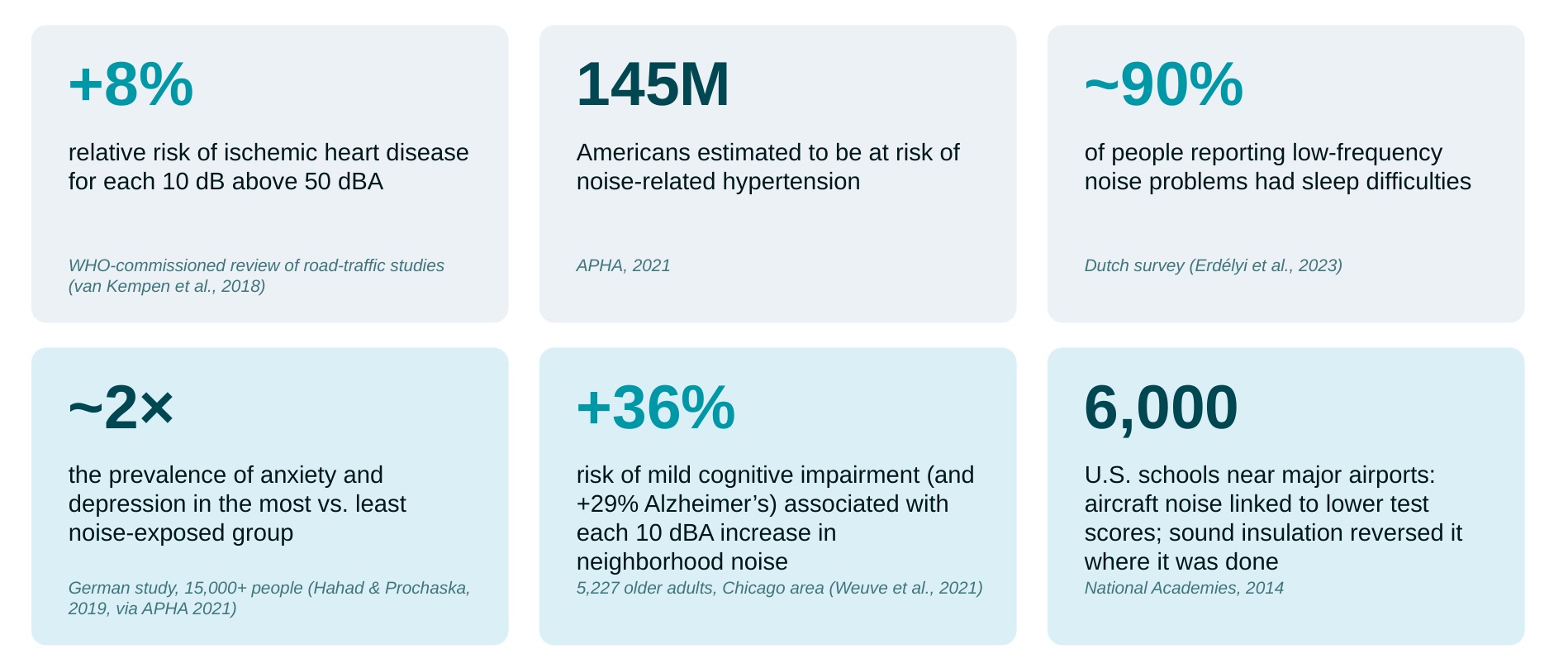
For a fuller discussion of this health effect evidence, with complete citations, see Health Effects of Data Center Noise.
The next page turns to how to measure the sound from data centers.

This website is designed to be shared
Download, print, or send this page to a neighbor, a doctor, or a local official.