
Reference Data center home / All paths / Health effects of data center noise
Health effects of data center noise
This page has four parts, followed by a list of references:

Research on noise exposure and health
The history of noise and health
Fifty-eight years ago, the world was put on notice that noise is not merely an annoyance but a measurable threat to health. In 1968, U.S. Surgeon General William H. Stewart told a national conference on the subject that noise produces “cardiovascular, glandular and respiratory effects reflective of the generalized stress reaction,” occurring “under sustained high level, or even moderately high noise conditions” (Stewart, 1968, in American Speech and Hearing Association, Proceedings of the Conference: Noise as a Public Health Hazard, Washington, DC).
The science behind that statement was formalized four years later when Congress passed the Noise Control Act of 1972, directing the EPA Administrator to “develop and publish criteria with respect to noise” reflecting “the scientific knowledge most useful in indicating the kind and extent of all identifiable effects of noise on the public health and welfare.” EPA met that Congressional mandate with Public Health and Welfare Criteria for Noise (EPA 550/9-73-002, July 27, 1973) — a comprehensive review of the health and welfare evidence then available, prepared by the agency’s Office of Noise Abatement and Control. A companion document followed the next year, Information on Levels of Environmental Noise Requisite to Protect Public Health and Welfare with an Adequate Margin of Safety (EPA 550/9-74-004, 1974), which translated that evidence into specific numeric levels — an outdoor day-night average of 55 dB and an indoor average of 45 dB as the threshold below which the public is protected with an adequate margin of safety.
The EPA’s 1978 publication, Noise: A Health Problem, articulates the stress and harmful health effects caused by chronic noise on health: hearing health, heart health, sleep, mental and social well-being. Furthermore, it emphasizes the special impacts it has on vulnerable populations, including children and the elderly and concludes with this statement from the former U.S. Surgeon General, Dr. William Stewart: “Calling noise a nuisance is like calling smog an inconvenience. Noise must be considered a hazard to the health of people everywhere.”
The science was expanded and detailed further in the World Health Organization’s landmark 1995 report, Community Noise (Berglund, B., & Lindvall, T., Eds., Archives of the Center for Sensory Research, 1995). That review examined and synthesized research from over 700 studies on the effect of noise on communication, sleep, the cardiovascular and psychophysiological systems, performance, and social behavior, and recognized the importance of the body’s stress response in mediating those impacts (Welch & Welch, 1970, and Cavatorta et al., 1987, as cited in Berglund & Lindvall, 1995).
This report formed the basis for the World Health Organization’s Community Noise Guidelines published in 1999 that are still cited today:
The WHO’s community guidelines provided average dBA-based thresholds for various situations and settings. For example, 55 LAeq for daytime outdoor noise, ≤ 40 LAeq for outdoor nighttime noise, and ≤ 35 LAeq in classroom settings. More recent guidelines from the WHO on nighttime noise (2009) and transportation and leisure noise (2018) recommend even lower levels.
How noise affects the body
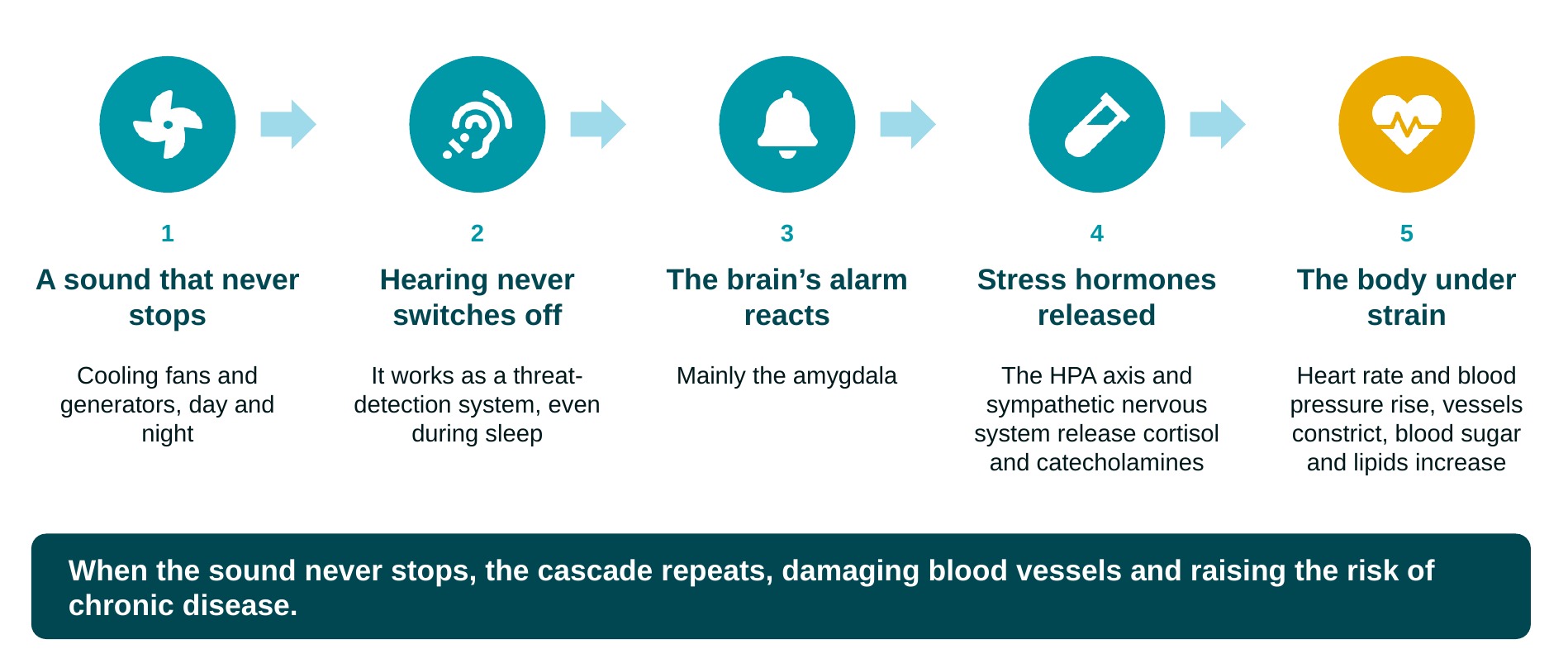
This link between noise and physical illness — heart disease chief among them — sits uneasily with how most people think about noise, which is simply an annoyance or nuisance rather than a health hazard. It makes more physiological sense once the mechanism is understood. Hearing is the one sense that cannot be voluntarily switched off: it functions as a threat-detection system, operating continuously, including during sleep. An unexpected or unwanted sound triggers the brain’s threat-response circuitry — principally the amygdala1 — which in turn activates the hypothalamic-pituitary-adrenal axis2 and the sympathetic nervous system3. The body responds as it would to any perceived threat: catecholamines4 and cortisol5 are released, heart rate and blood pressure rise, blood vessels constrict, and blood sugar and blood lipids increase. This is the same acute “startle” response that evolved to help humans and animals survive danger. In situations where the source of the sound never stops — as with data centers — the stress-response cascade is repeatedly activated, damaging the blood vessels and raising the risk of chronic disease (Basner et al., 2014; Münzel et al., 2018). Longer lasting activation and elevated cortisol level raise the risk of developing chronic disease including suppression of the immune system (e.g., eosinopenia6), insulin resistance (e.g., diabetes), cardiovascular diseases (e.g., hypertension and arteriosclerosis7), catabolism8 (e.g., osteoporosis), and intestinal problems (e.g., stress ulcer), etc. Other impacts may be widespread, potentially affecting other regulatory systems of the body through mechanisms like disturbances in hormonal balance (Spreng, 2000a, 2000b).
Terms used in this section
- A small, almond-shaped part of the brain that detects possible threats and triggers the body’s alarm response. ↩
- The chain of hormone signals running from the brain (the hypothalamus and pituitary gland) to the adrenal glands above the kidneys. It releases stress hormones, including cortisol. ↩
- The part of the nervous system that speeds the heart and raises blood pressure when the body senses danger — the “fight-or-flight” response. ↩
- Stress hormones, including adrenaline and noradrenaline, that speed the heart and raise blood pressure. ↩
- The body’s main long-acting stress hormone. It raises blood sugar and readies the body to respond to a threat; kept high for long periods, it can damage health. ↩
- An abnormally low count of eosinophils, a type of white blood cell. Here it is cited as a sign of a suppressed immune response to chronic stress. ↩
- Thickening and stiffening of the artery walls, often called “hardening of the arteries.” ↩
- The body breaking down its own tissues for energy. Prolonged stress hormones can drive this, for example the loss of bone that leads to osteoporosis. ↩
- 1
A sound that never stops
Cooling fans and generators, day and night
- 2
Hearing never switches off
It works as a threat-detection system, even during sleep
- 3
The brain’s alarm reacts
Mainly the amygdala
- 4
Stress hormones released
The HPA axis and sympathetic nervous system release cortisol and catecholamines
- 5
The body under strain
Heart rate and blood pressure rise, vessels constrict, blood sugar and lipids increase
When the sound never stops, the cascade repeats, damaging blood vessels and raising the risk of chronic disease.
What we now know about the noise from data centers
Data center noise has a specific acoustic profile that matters for how this evidence applies: it is continuous — operating 24 hours a day, 365 days a year, with no respite period — and it carries substantial low-frequency, tonal content from cooling fans, generators, co-located power sources, and electrical equipment.
Major industrial sources with strong low frequency components include ventilation systems, compressors, diesel engines, transportation vehicles, and heavy construction equipment (e.g., excavators, dozers, cranes, generators), all of which pertain to data centers and their construction. Noise with dominant low frequency components travels long distances, readily penetrates walls and windows, and accounts for the majority of noise complaints (Bengtsson 2003; Persson 1988; Persson Waye 2001).
Low frequency noise is a well-established but underappreciated risk to human health (WHO 1999; Leaffer 2025; Leventhall 2004) with a greater negative impact on annoyance, sleep disturbance, and nonauditory health (Berglund 1995; WHO 1999; Persson Waye 2001; Ascari 2015; Broner 1985; Erdélyi 2024). These types of noise sources can cause distress at lower levels than higher frequency noise.
Continual exposure, especially during the night, prevents the body from recuperating. This is especially important because of the impacts of continual activation of the stress cascade and disproportionate hazard associated with nighttime noise, consistent with sleep’s role as a period of physiological restoration (Münzel et al., 2020; Spreng, 2000a, 2000b)
Because so much of the sound energy of data center noise is in the low-frequency range, standard A-weighted decibel measurement (dBA) — the near-universal basis for noise ordinances — substantially understates the exposure and geographic area that may be affected and does not account for the intrusion of the noise into the interior of homes and other buildings. Reliance on the dBA to measure sound with prominent low frequency components has been widely criticized as inadequate by national and international agencies, including the National Academy of Engineering (NAE 2010) and the WHO (WHO 1999), as well as by scientists and acoustic professionals.
Related to that is the inadequacy of the dBA as a basis for modeling the impact of noise over distance.
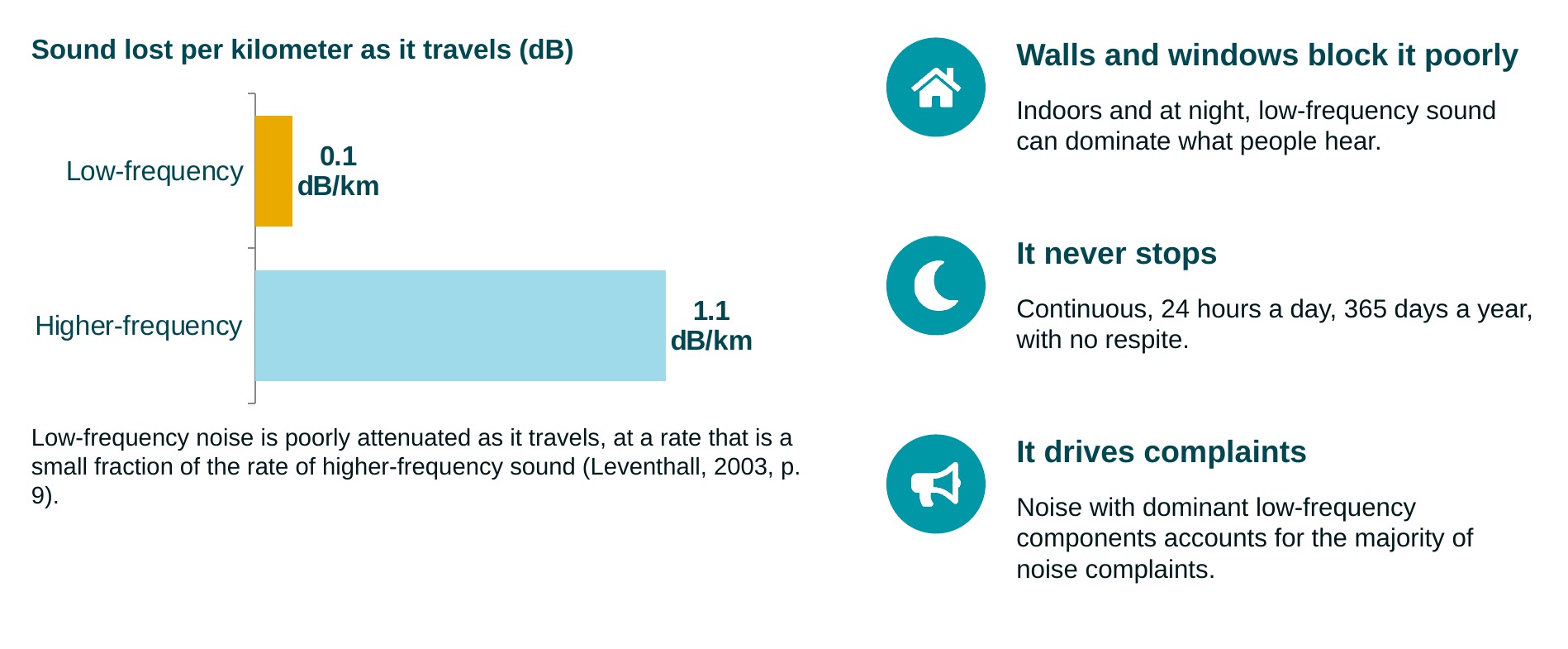
Attenuation rates for low frequency sound are a small fraction of that of higher frequency sound, e.g., 0.1 dB/km vs 1.1 dB/km (Leventhall, 2003, p. 9). This can result in predicting much lower levels at a distance than what is actually heard and experienced by those exposed.
Walls, windows and hearing protection do not block the intrusion of low frequency sound (Berglund et al., 1996, pp. 2988, 2996). Therefore, indoors and at night, low frequencies may be primarily what people hear (Persson & Björkman, 1988, cited in Berglund et al., 1996, p. 2987). The presence of tonal elements makes the noise even more disturbing and the effect is accentuated in quiet settings such as bedrooms at night.
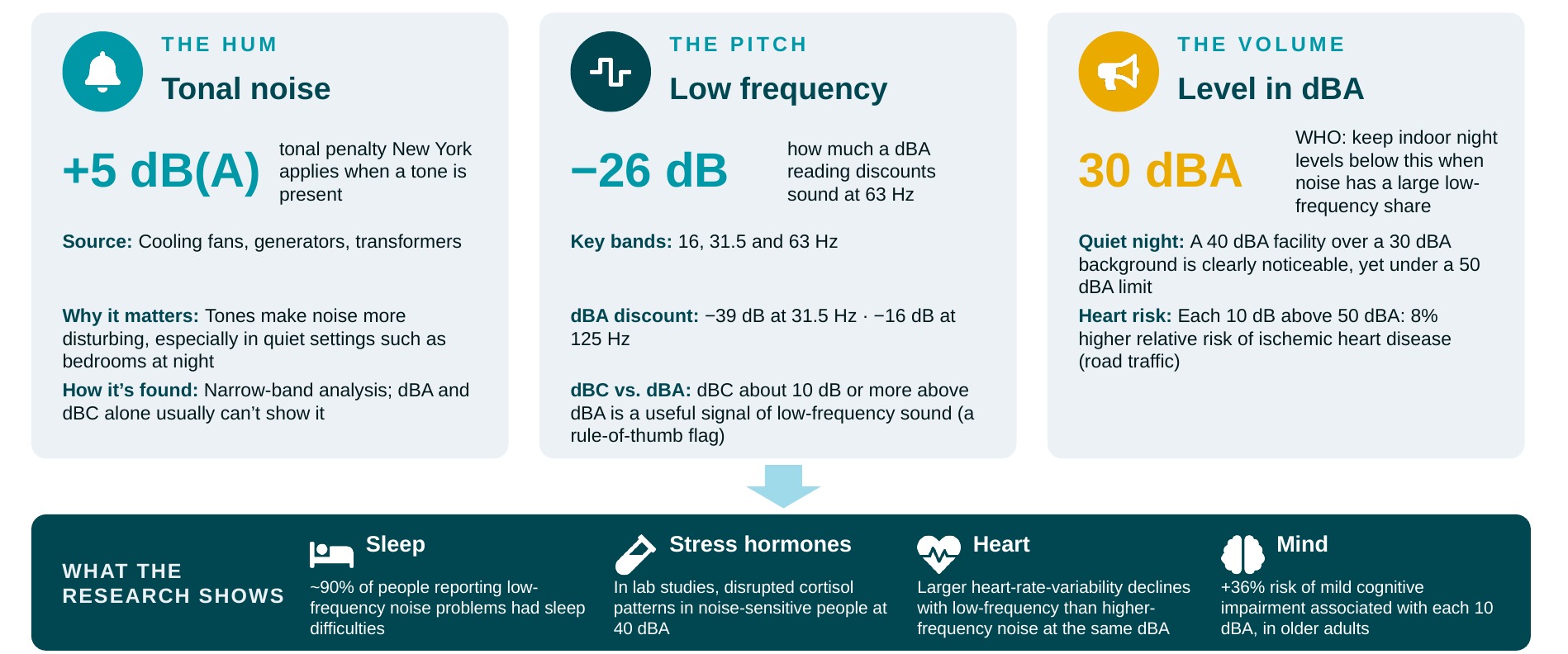
The degree to which the dBA discounts low frequency sound energy is substantial, roughly 16 dB at 125 Hz, 26 dB at 63 Hz, and 39 dB at 31.5 Hz (IEC 61672-1), removing about 97% of the energy at 125 Hz and 99% or more at 63 and 31.5 Hz.
Sound lost per kilometer as it travels (dB)
Low-frequency noise is poorly attenuated as it travels, at a rate that is a small fraction of the rate of higher-frequency sound (Leventhall, 2003, p. 9).
Walls and windows block it poorly
Indoors and at night, low-frequency sound can dominate what people hear.
It never stops
Continuous, 24 hours a day, 365 days a year, with no respite.
It drives complaints
Noise with dominant low-frequency components accounts for the majority of noise complaints.
The hum
Tonal noise
tonal penalty New York applies when a tone is present
- Source:
- Cooling fans, generators, transformers
- Why it matters:
- Tones make noise more disturbing, especially in quiet settings such as bedrooms at night
- How it’s found:
- Narrow-band analysis; dBA and dBC alone usually can’t show it
The pitch
Low frequency
how much a dBA reading discounts sound at 63 Hz
- Key bands:
- 16, 31.5 and 63 Hz
- dBA discount:
- −39 dB at 31.5 Hz · −16 dB at 125 Hz
- dBC vs. dBA:
- dBC about 10 dB or more above dBA is a useful signal of low-frequency sound (a rule-of-thumb flag)
The volume
Level in dBA
WHO: keep indoor night levels below this when noise has a large low-frequency share
- Quiet night:
- A 40 dBA facility over a 30 dBA background is clearly noticeable, yet under a 50 dBA limit
- Heart risk:
- Each 10 dB above 50 dBA: 8% higher relative risk of ischemic heart disease (road traffic)
What the research shows
Sleep
~90% of people reporting low-frequency noise problems had sleep difficulties
Stress hormones
In lab studies, disrupted cortisol patterns in noise-sensitive people at 40 dBA
Heart
Larger heart-rate-variability declines with low-frequency than higher-frequency noise at the same dBA
Mind
+36% risk of mild cognitive impairment associated with each 10 dBA, in older adults
Specific health effects
Cardiovascular disease. The association between chronic environmental noise exposure and cardiovascular disease — hypertension, atherosclerosis, heart failure, stroke, arrhythmia, and cardiovascular mortality – is firmly established, supported by extensive evidence and guidelines (Münzel et al., 2026, accepted for publication; WHO 2018; APHA 2021; EEA 2025). Roughly 145 million Americans are estimated to be at risk of noise-related hypertension (Swinburn 2015; APHA, 2021). Many studies have demonstrated exposure-response relationships between noise and health outcomes. For example, a WHO-commissioned systematic review of road-traffic-noise studies found each 10 dB increase above 50 dBA was associated with an 8% increase in the relative risk of ischemic heart disease and reached consistent conclusions for cardiovascular and metabolic outcomes generally (van Kempen et al., 2018).
Most studies of noise effects on health involve transportation noise (air, road, rail), which all contain prominent low frequency components. For instance, road traffic noise contains low frequency components and may also contain tonal elements under certain circumstances, e.g., hard acceleration or modified exhaust systems. Other studies indicate the effect of low frequency noise on the stress response. For instance, one study found larger falls in heart rate variability with low frequency noise than with higher-frequency noise at the same dBA (Walker et al., 2016); another study found that low frequency noise was related to higher cortisol levels in noise-sensitive people (Persson Waye et al., 2002).
Sleep disruption. Nighttime noise disrupts sleep architecture — increasing awakenings and stage changes — even at levels well below what most people would describe as loud, and even when the sleeper does not consciously wake (Basner et al., 2014). The difference between data center noise and background noise can be considerably greater at night. This, in combination with fluctuations in the data center noise due to factors like power surges and temperature inversions, can disrupt sleep, normal hormonal cycles, and physiological recovery (Basner et al., 2014; Münzel et al., 2021).
Sleep disruption from low frequency noise exposure is a common complaint. About 90% of people reporting low frequency noise problems in a Dutch survey had sleep difficulties (Erdélyi et al., 2024, pp. 11–12). WHO community guidelines recommend levels below 30 dBA indoors at night when noise has a large low frequency share (Berglund et al., 1999, §4.2.3). Because of the ability of low frequency noise to readily penetrate walls and windows, indoor noise measurements with appropriate metrics are needed (WHO 2018).
Metabolic effects. Chronic noise-related sleep disruption and stress-hormone elevation are associated with problems in how the body controls insulin and blood sugar, implicating environmental noise as a contributing factor in diabetes risk (Münzel et al., 2026, accepted for publication; van Kempen et al., 2018; APHA, 2021).
Anxiety and depression. A substantial and recent literature connects environmental noise exposure to anxiety and depression, operating through the same stress-hormone mechanism implicated in cardiovascular disease (Hahad, 2024; Hahad, 2019). A German study of over 15,000 individuals found the highest noise-exposure group carrying roughly double the prevalence of anxiety and depression compared with the least-exposed group (Hahad, 2019, as summarized in APHA, 2021).
Cognitive effects on children. Chronic noise exposure impairs children’s reading comprehension, memory, and listening skills (Klatte et al., 2013; Stansfeld 2015). A ten-year study of 6,000 U.S. schools near major airports found aircraft noise associated with lower standardized test scores — an effect that installing sound insulation reversed in the subset of schools where it was done (NASEM, 2014).
Cognitive decline, dementia, and Parkinson’s disease. A 2021 study of 5,227 older adults in the Chicago area suggests that each 10 dBA increase in neighborhood noise is associated with a 36% increase in the risk of mild cognitive impairment and a 29% increase in the risk of Alzheimer’s disease (Weuve et al., 2021). Other studies found relationships between chronic noise exposure, Alzheimer’s dementia, and Parkinson’s disease (Sorensen, 2026; Lomme, 2023).
Effects on wildlife and other animals. Chronic noise disrupts animal communication, mating behavior, predator avoidance, and foraging, with measurable reductions in local biodiversity (Barber, 2010; National Park Service, Natural Sounds and Night Skies Division; Kunc, 2019), and documented stress-physiology changes in birds specifically (Kleist, 2018).
Environmental justice. Noise exposure in the United States is not evenly distributed: nationwide studies find exposure to road and air traffic noise highest in minority and low-income neighborhoods, and in public schools serving lower-income and minority student populations (Casey, 2017; Collins, 2020; Collins, 2019) — a pattern with plausible relevance to siting decisions for industrial facilities more broadly.
Vulnerable Populations. Certain groups within the general population are especially vulnerable to the adverse impacts of noise, including infants and children, seniors, pregnant women, those with pre-existing conditions, e.g., hearing disorders, neurodivergence, cardiovascular disease, psychiatric disorders, post-traumatic stress, and others who may be confined to the home (van Kamp 2013; Stansfeld 1992; Wicki 2024), as well as people for whom quiet is necessary to do their work, such as writers, analysts, musicians, composers, scholars, and others. Noise exposure has also been linked to higher risk of mortality in vulnerable populations (Saucy, 2021; Itzkowitz, 2023; Jin 2024).
Institutional recognition. Noise as a public health hazard is formally recognized by the World Health Organization, the American Public Health Association (APHA, 2021), the American Academy of Pediatrics (AAP 2024), the American Academy of Nursing (Lusk 2016; McCullagh et al., 2026), and scientific leaders (Balk 2026). The problems presented by low frequency noise and the inadequacy of the standard metric, the dBA, to evaluate community impacts is also recognized by national and international organizations including the World Health Organization (1999, 2018), the National Academy of Engineering (NAE 2010), and the EPA (EPA 1982).
How noise impairs learning
References
American Academy of Pediatrics. Noise; Promoting health environments for children. Accessed October 22, 2026 at https://downloads.aap.org/AAP/PDF/HealthyEnv_Noise.pdf (website updated January 11, 2024).
American Public Health Association. Noise as a Public Health Hazard. Policy Statement 202115. October 25, 2021. APHA policy statement.
Ascari E, Licitra G, Teti L, Cerchiai M. Low frequency noise impact from road traffic according to different noise prediction methods. Sci Total Environ. 2015 Feb 1;505:658-69. doi: 10.1016/j.scitotenv.2014.10.052
Balk SJ, Neitzel R. Decreasing Noise Exposure Should Be a Public Health Priority. Public Health Rep. 2026 Jan-Feb;141(1):11-16. doi: 10.1177/00333549251372051.
Barber, J.R., Crooks, K.R., & Fristrup, K.M. (2010). The costs of chronic noise exposure for terrestrial organisms. Trends in Ecology & Evolution, 25(3), 180–189.
Basner, M., Babisch, W., Davis, A., et al. (2014). Auditory and non-auditory effects of noise on health. The Lancet, 383(9925), 1325–1332.
Bengtsson J, Waye KP. Assessments of Low Frequency Noise Complaints among the Local Environmental Health Authorities and a Follow-up Study 14 Years Later. Journal of Low Frequency Noise, Vibration and Active Control. 2003;22(1):9-16. doi:10.1260/026309203769018040
Berglund B, Hassmén P, Job RF. Sources and effects of low-frequency noise. J Acoust Soc Am. 1996 May;99(5):2985-3002. doi: 10.1121/1.414863.
Berglund, B., & Lindvall, T. (Eds.). (1995). Community Noise. Archives of the Center for Sensory Research, 2(1), 1–195. World Health Organization.
Broner, N. and Leventhall, H. G. (1985). “Annoyance Loudness and Unacceptability of Higher Level Low Frequency Noise.” Journal of Low Frequency Noise, Vibration and Active Control, 4(1), 1–11.
Casey JA, Morello-Frosch R, Mennitt DJ, Fristrup K, Ogburn EL, James P. Race/Ethnicity, Socioeconomic Status, Residential Segregation, and Spatial Variation in Noise Exposure in the Contiguous United States. Environ Health Perspect. 2017 Jul 25;125(7):077017. doi: 10.1289/EHP898.
Collins, T.W., Grineski, S.E., & Nadybal, S. (2019). Social disparities in exposure to noise at public schools in the contiguous United States. Environmental Research, 175, 257–265.
Collins, T.W., Nadybal, S., & Grineski, S.E. (2020). Sonic injustice: Disparate residential exposures to transport noise from road and aviation sources in the continental United States. Journal of Transport Geography, 82, 102604.
Erdélyi KH, Fuermaier ABM, Tucha L, Tucha O, Koerts J. Subjective Complaints and Coping Strategies of Individuals with Reported Low-Frequency Noise Perceptions. J Clin Med. 2024 Feb 6;13(4):935. doi: 10.3390/jcm13040935
European Environment Agency (EEA). Environmental noise in Europe – 2025. In: EEA report 05/2025. Copenhagen; 2025
Hahad, O., & Prochaska, J.H. (2019). Environmental noise-induced effects on stress hormones, oxidative stress, and vascular dysfunction. Oxidative Medicine and Cellular Longevity, 2019, 4623109.
Hahad, O., Kuntic, M., Al-Kindi, S., et al. (2024). Noise and mental health: evidence, mechanisms, and consequences. Journal of Exposure Science & Environmental Epidemiology.
Itzkowitz N, Gong X, Atilola G, Konstantinoudis G, Adams K, Jephcote C, Gulliver J, Hansell AL, Blangiardo M. Aircraft noise and cardiovascular morbidity and mortality near Heathrow Airport: A case-crossover study. Environment international. 2023;177:108016. doi: 10.1016/j.envint.2023.108016
Jin T, Kosheleva A, Castro E, Qiu X, James P, Schwartz J. Long-term noise exposures and cardiovascular diseases mortality: A study in 5 U.S. states. Environ Res 2024;245:118092. doi: 10.1016/j.envres.2023.118092
Klatte, M., Bergström, K., & Lachmann, T. (2013). Does noise affect learning? A short review on noise effects on cognitive performance in children. Frontiers in Psychology, 4, 578.
Kleist, N.J., Guralnick, R.P., Cruz, A., Lowry, C.A., & Francis, C.D. (2018). Chronic anthropogenic noise disrupts glucocorticoid signaling and has multiple effects on fitness in an avian community. Proceedings of the National Academy of Sciences, 115(4).
Kunc HP, Schmidt R. The effects of anthropogenic noise on animals: a meta-analysis. Biol Lett. 2019 Nov 29;15(11):20190649. doi: 10.1098/rsbl.2019.0649. Epub 2019 Nov 20.
Leaffer DJ, Suh H, Durant JL, Tracey B, Roof C, Gute DM. Long-term measurement study of urban environmental low frequency noise. J Expo Sci Environ Epidemiol. 2025 Sep 11. doi: 10.1038/s41370-023-00599-x.
Leventhall, G. (assisted by Pelmear, P., & Benton, S.). (2003). A review of published research on low frequency noise and its effects. Report for the Department for Environment, Food and Rural Affairs (Defra), London
Leventhall, HG. Low frequency noise and annoyance. Noise & Health 2004; 6:59–72.
Lomme J, Reedijk M, Peters S, Downward GS, Stefanopoulou M, Vermeulen R, Huss A. Traffic-related air pollution, road traffic noise, and Parkinson’s disease: Evaluations in two Dutch cohort studies. Environ Epidemiol. 2023 Oct 19;7(6):e272. doi: 10.1097/EE9.0000000000000272.
Lusk SL, McCullagh M, Dickson VV, Xu J. Position statement: Harmful effects of environmental noise exposures. Nurs Outlook. 2016 Jul-Aug;64(4):395-396. doi: 10.1016/j.outlook.2016.06.001.
McCullagh MC, Lee SK, Dickson VV, Lusk SL. Reduce noise: Enhance health equity-An AAN Consensus Paper. Nurs Outlook. 2026 May-Jun;74(3):102760. doi: 10.1016/j.outlook.2026.102760.
Münzel, T., Schmidt, F.P., Steven, S., Herzog, J., Daiber, A., & Sørensen, M. (2018). Environmental noise and the cardiovascular system. Journal of the American College of Cardiology, 71(6), 688–697.
Münzel, T., Kröller-Schön, S., Oelze, M., et al. (2020). Adverse cardiovascular effects of traffic noise with a focus on nighttime noise and the new WHO noise guidelines. Annual Review of Public Health, 41, 309–328.
Münzel T, Steven S, Hahad O, Daiber A. Noise and cardiovascular risk: nighttime aircraft noise acutely triggers cardiovascular death. Eur Heart J. 2021 Feb 21;42(8):844-846. doi: 10.1093/eurheartj/ehaa984.
Münzel T, Sørensen M, Osborne MT, Basner M, Röösli M, Angell SY, Banks JL, Rajagopalan S. Environmental Noise and Cardiometabolic Health: Evidence, Pathways, and Prevention: A European and US Expert Statement. Eur Heart J 2026 (accepted for publication)
National Academies of Sciences, Engineering, and Medicine (NASEM). (2014). Assessing Aircraft Noise Conditions Affecting Student Learning, Volume 1: Final Report. National Academies Press.
National Academy of Engineering (NAE). Technology for a Quieter America; The National Academies Press: Washington, DC, USA, 2010.
National Park Service, Natural Sounds and Night Skies Division. U.S. Department of the Interior.
Persson K, Rylander R. Disturbance from low-frequency noise in the environment: A survey among the local environmental health authorities in Sweden. J Sound Vibration 1988; 121:339-345.
Persson Waye K, Rylander R. The prevalence of annoyance and effects after long-term exposure to low-frequency noise. J Sound Vibration 2001;240: 483-497. doi: 10.1006/jsvi.2000.3251.
Persson Waye, K., Bengtsson, J., Rylander, R., Hucklebridge, F., Evans, P., & Clow, A. (2002). Low frequency noise enhances cortisol among noise sensitive subjects during work performance. Life Sciences, 70(7), 745–758.
Saucy A, Schaffer B, Tangermann L, Vienneau D, Wunderli JM, Roosli M. Does night-time aircraft noise trigger mortality? A case-crossover study on 24 886 cardiovascular deaths. Eur Heart J. 2021;42:835-843. doi: 10.1093/eurheartj/ehaa957
Sørensen M, Poulsen AH, Raaschou-Nielsen O, Thygesen LC, Brandt J, Andersen C, Münzel T. Road Traffic Noise, Noise Difference Between Residential Facades, and Risk of Parkinson Disease. JAMA Neurol. 2026 Sep 1;83(9):851-859. doi: 10.1001/jamaneurol.2026.2262.
Spreng M (2000a). Central nervous system activation by noise. Noise & Health, 2 (7):49–58.
Spreng M (2000b). Possible health effects of noise induced cortisol increase. Noise Health. 2000;2(7):59-64.
Stansfeld SA. Noise, noise sensitivity and psychiatric disorder: epidemiological and psychophysiological studies. Psychol Med. 1992;Suppl 22:1-44.
Stansfeld S, Clark C. Health Effects of Noise Exposure in Children. Curr Environ Health Rep. 2015 Jun;2(2):171-8. doi: 10.1007/s40572-015-0044-1.
Stewart, W.H. (1968). Address to the Conference on Noise as a Public Health Hazard. In Proceedings of the Conference: Noise as a Public Health Hazard. American Speech and Hearing Association.
Swinburn, T.K., Hammer, M.S., & Neitzel, R.L. (2015). Valuing quiet: An economic assessment of U.S. environmental noise as a cardiovascular health hazard. American Journal of Preventive Medicine, 49(3), 345–353.
U.S. Environmental Protection Agency. (1973). Public Health and Welfare Criteria for Noise (EPA 550/9-73-002).
U.S. Environmental Protection Agency. (1974). Information on Levels of Environmental Noise Requisite to Protect Public Health and Welfare with an Adequate Margin of Safety (EPA 550/9-74-004).
U.S. Environmental Protection Agency. (1982). Guidelines for Noise Impact Analysis (EPA 550/9-82-105).
van Kamp I, Davies H. Noise and health in vulnerable groups: a review. Noise & Health. 2013 May-Jun;15(64):153-9. doi: 10.4103/1463-1741.112361.
van Kempen, E., Casas, M., Pershagen, G., & Foraster, M. (2018). WHO environmental noise guidelines for the European region: a systematic review on environmental noise and cardiovascular and metabolic effects. International Journal of Environmental Research and Public Health, 15(2), 379.
Walker, E. D., Brammer, A., Cherniack, M. G., Laden, F., & Cavallari, J. M. (2016). Cardiovascular and stress responses to short-term noise exposures: A panel study in healthy males. Environmental Research, 150, 391–397.
Weuve, J., D’Souza, J., Beck, T., et al. (2021). Long-term community noise exposure in relation to dementia, cognition, and cognitive decline in older adults. Alzheimer’s & Dementia; 17: 525–533.
Wicki B, Vienneau D, Schäffer B, Müller TJ, Raub U, Widrig J, Pervilhac C, Röösli M. Acute effects of military aircraft noise on sedative and analgesic drug administrations in psychiatric patients: A case-time series analysis. Environ Int. 2024 Mar;185:108501. doi: 10.1016/j.envint.2024.108501.
World Health Organization (1999). Guidelines for Community Noise. B Berglund, T Lindvall, DH Schwela (eds). World Health Organization: Geneva.
World Health Organization. (2018). Environmental Noise Guidelines for the European Region. WHO Regional Office for Europe.

This website is designed to be shared
Download, print, or send this page to a neighbor, a doctor, or a local official.